





 +60173309581
What Malaysian University Graduates Actually Earn in 2026: Latest Salary Data
September 11, 2026
Mehmil

You graduate, land your first job and get offered RM3,000 a month. Then a friend tells you, “You should've studied IT — they earn way more.”
So, what should a Malaysian graduate actually expect to earn in 2026?
The answer depends on what you study, the career you enter and where you work.
Graduate salaries can vary significantly between fields, while skills, experience and location can also affect what you earn.
This guide breaks down the latest available salary data by course, field, university, experience level and location — so you can understand your earning potential before choosing your degree.
What's the Average Starting Salary for Malaysian Graduates?
A fresh graduate in Malaysia typically starts at around RM2,800–RM3,200 a month, although starting salaries vary by field, employer and location.
Some in-demand fields can offer considerably more, while others start closer to RM2,500.
The national formal-sector median wage is RM3,167 a month, but this covers workers across different ages and experience levels — not just fresh graduates.
Average vs Median: What's the Difference?
The average (mean) can be pushed higher by a smaller group of high earners.
The median represents the middle point: half earn more and half earn less. It's often more useful when you're trying to understand what a typical worker earns.
Around 65% of fresh graduates earn below RM3,000 a month, so a first offer around RM2,800–RM3,000 isn't necessarily unusual.
Graduate Salaries Are Rising
Official DOSM data shows that salaries across the entire employed graduate population have increased:
| Year | Median Monthly Salary | Mean Monthly Salary |
|---|---|---|
| 2023 | RM 4,409 | RM 4,933 |
| 2024 | RM 4,521 | RM 5,330 |
These figures include graduates at different stages of their careers, not just fresh graduates.
Graduate unemployment also fell from 3.4% in 2023 to 3.2% in 2024.
Source: Department of Statistics Malaysia (DOSM), Graduates Statistics 2024, released 31 October 2025.
Salary by Field of Study: What Different Degrees Actually Pay
Your field of study can have a major impact on your starting salary. But your skills, experience, employer and location also matter.
| Field | Avg. Starting Salary | Typical Range |
|---|---|---|
| Medicine / Health Sciences | RM 4,800 | RM 4,200–RM 8,000 |
| IT / Computer Science | RM 4,300 | RM 3,500–RM 6,000 |
| Engineering | RM 3,800 | RM 3,200–RM 4,800 |
| Accounting / Finance | RM 3,400 | RM 2,800–RM 4,500 |
| Business / Management | RM 3,200 | RM 2,600–RM 4,000 |
| Law | RM 3,000 | RM 2,500–RM 4,000 |
| General Sciences | RM 3,000 | RM 2,500–RM 3,800 |
| Education | RM 2,800 | RM 2,500–RM 3,500 |
| Arts / Social Sciences / Mass Comm | RM 2,600 | RM 2,200–RM 3,200 |
Indicative fresh-graduate salary ranges. Actual offers vary by role, employer, location, qualifications and experience.
Want role-specific numbers? Specialist roles like AI/ML and cybersecurity can pay well above the field average; see our full high-demand jobs and salaries for 2026 graduates breakdown.
What Explains the Differences?
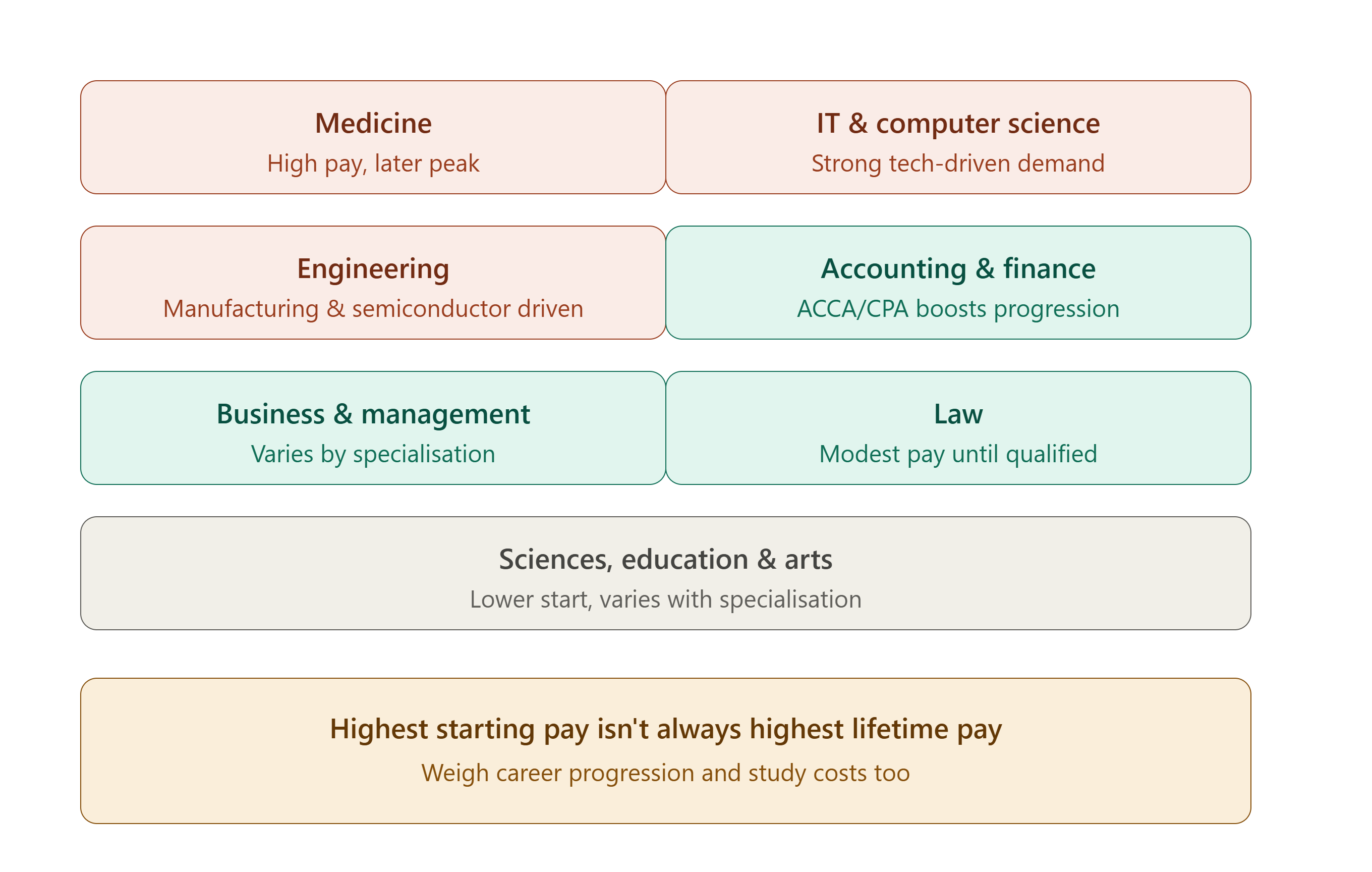
Medicine: Potentially high long-term earnings, but graduates go through housemanship and early-career training before progressing into more specialised roles.
IT & Computer Science: Strong demand in software, cybersecurity, cloud, data, AI and fintech can create attractive starting salaries.
Engineering: Electrical & electronics, semiconductor, automation and manufacturing roles benefit from Malaysia's industrial base.
Accounting & Finance: Professional qualifications such as ACCA and CPA can open additional career and progression opportunities.
Business & Management: A broad field, meaning salary varies significantly depending on specialisation, employer and industry.
Law: Starting pay can be modest during chambering, with career options expanding after qualification.
Sciences, Education & Arts: Starting salaries tend to be lower in this comparison, but specialisation, experience and career direction can significantly change outcomes.
The highest starting salary isn’t always the highest long-term salary. Consider career progression, qualification requirements, and total study costs—not just your first paycheque.
How Does Your Salary Change With Experience?
Your first salary is only the starting point. As you gain experience, develop specialist skills and move into higher-responsibility roles, your earning potential can change significantly.
Here's a broad picture:
| Career Stage | Typical Monthly Salary (RM) | What Matters Most |
|---|---|---|
| Entry-level (0–1 year) | RM 2,800–RM 4,500 | Course, skills, internship and first role |
| Early career (1–3 years) | RM 3,500–RM 6,000 | Experience, performance and in-demand skills |
| Experienced (5+ years) | RM 6,000–RM 12,000+ | Specialisation, leadership and industry |
Salary ranges are indicative and vary considerably by field, employer, location and role.
0–1 Year: Getting Your Foot in the Door
Your degree, internship experience and practical skills can matter most when you're applying for your first job.
CGPA may help you get through the door for some graduate roles, but its importance generally decreases as you build actual work experience.
1–3 Years: Experience Starts to Matter More
After a few years, employers are more interested in what you can actually do.
Salary growth can come from:
- Taking on more responsibility
- Moving into an in-demand specialisation
- Building technical or industry-specific skills
- Earning relevant professional certifications
- Moving to a role or employer with better career progression
For example, an IT graduate might specialise in cloud, cybersecurity or data, while an accounting graduate may pursue ACCA or CPA.
5+ Years: Specialisation Can Make a Big Difference
By this stage, your experience and expertise generally matter more than your degree alone.
Higher salaries are often associated with:
- Specialist or technical roles
- Management responsibilities
- Professional qualifications
- High-demand industries
- Strong track records of performance
A postgraduate qualification can help with some career paths, particularly when it is directly relevant to the role you're targeting. But a Master's or MBA isn't automatically a shortcut to a higher salary.
Don’t ask only, “What’s the starting salary?” Ask “What can this career pay after 5–10 years?” A degree with a modest starting salary may have stronger long-term potential than one that pays more on day one.
Salary by University: Does It Matter Where You Study?
Yes, your university matters — but probably not in the way you think.
Malaysia doesn't currently publish comprehensive official graduate salary data for individual universities. DOSM reports graduate earnings by factors such as education level, field of study and state, but doesn't provide a reliable university-by-university salary ranking.
So be careful with claims like “University X graduates earn more than University Y.” Without considering the course, industry, experience and location, these comparisons can be misleading.
Public vs Private: Which Is Better for Your Salary?

There isn't a simple public vs private answer.
Malaysia's leading public universities, including UM, UKM, USM, UPM and UTM, offer strong programmes across medicine, engineering, science and technology.
Established private universities such as Taylor's University, Monash Malaysia, Sunway University and Nottingham Malaysia also have strong programmes and industry connections across areas such as business, IT, engineering, hospitality and health sciences.
So instead of asking:
“Is public or private better for my salary?”
Ask:
“How strong is this particular programme for the career I want?”
Where Your University Can Make a Difference
Your university can influence your career opportunities through the programme you choose, industry exposure and connections to employers.
When comparing universities, look at:
- Programme strength in your chosen field
- Industry partnerships and employer connections
- Internship and placement opportunities
- Professional accreditation, where required
- Career support and graduate outcomes
- Location and access to relevant industries
For example, if you're interested in semiconductors, an engineering programme with strong links to Malaysia's electronics industry may be more useful than choosing a university simply because it has a higher overall ranking.
Similarly, for hospitality, industry placements and practical experience may matter more to your career than the university's overall ranking.
University brand plays a smaller role than most students assume — specialization, internships, and demonstrated skills matter more. We break this down further in does university choice really matter for getting a job in Malaysia.
Salary by State: Does Location Change Your Pay?
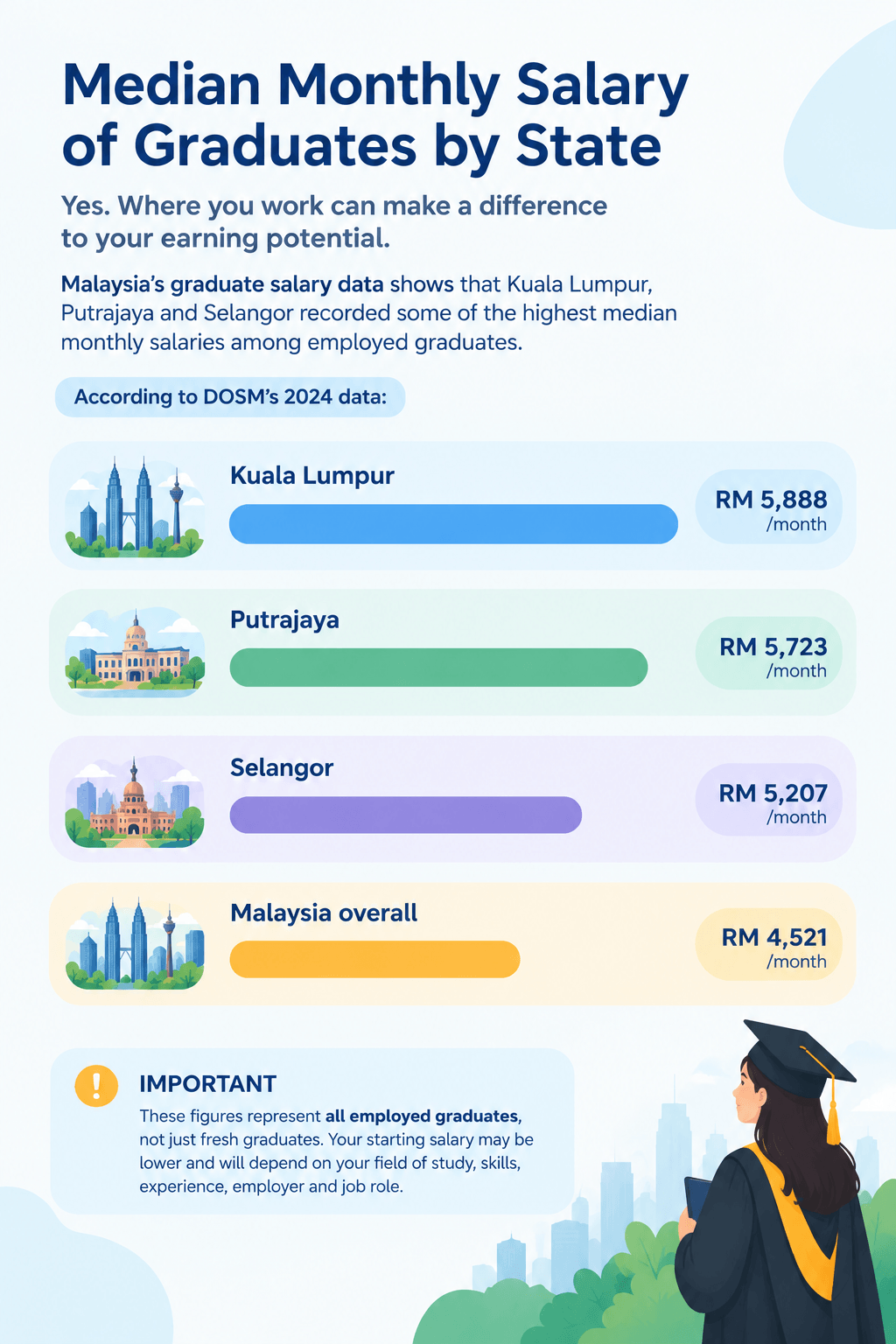
Yes. Where you work can affect your salary — but higher pay doesn't always mean more money in your pocket.
Malaysia's graduate salary data shows that Kuala Lumpur, Putrajaya and Selangor have some of the highest median salaries among employed graduates.
According to DOSM's 2024 data:
- Kuala Lumpur: RM5,888
- Putrajaya: RM5,723
- Selangor: RM5,207
- Malaysia overall: RM4,521
These figures cover all employed graduates, not just fresh graduates. Don’t use them as a direct benchmark for your first salary.
Why Does Location Matter?
Higher-paying jobs tend to cluster around major business and industry centres.
Klang Valley is a major hub for:
- Finance and banking
- Technology
- Consulting
- MNCs
- Corporate and professional services
Penang is particularly important for:
- Semiconductors
- Electrical & electronics
- Manufacturing
- Engineering
Other states can offer strong opportunities too, particularly in sectors such as healthcare, education, tourism, manufacturing and government.
Don’t choose a job location based on salary alone. Compare your salary with rent, transport, and daily expenses. A slightly lower salary in a cheaper city can sometimes leave you with more disposable income.
Should You Move to KL for a Higher Salary?
Not necessarily.
A higher salary in Kuala Lumpur can come with higher housing and living costs. What matters is how much of your salary you actually have left after expenses.
For example, a RM3,400 offer in KL isn't automatically better than a RM3,000 offer in a lower-cost location.
KL's pull isn't just pay; it's also consistently ranked one of the world's best student cities, thanks to the same employer density that drives its salary premium.
What Should You Take Away From Malaysia's Graduate Salary Data?
Salary is worth considering when choosing a degree, but it shouldn't be the only factor.
Your field of study, skills, experience, industry and location can all influence what you earn after graduation. A degree with a higher starting salary isn't necessarily the best choice if it doesn't match your interests, career goals or budget.
Instead of asking “Which degree pays the most?”, ask “Which course gives me the best path towards the career I want?”
🎓 Ready to Choose Your Course?
Compare courses, universities, tuition fees, entry requirements and career options on EasyUni to find a programme that fits your goals and budget.
Explore Courses & Universities on EasyUni →Frequently Asked Questions
1. What is the average salary of a fresh graduate in Malaysia?
Fresh graduates in Malaysia typically start at around RM2,800–RM3,200 per month, although salaries vary by course, industry, location and employer.
2. Which degree has the highest starting salary in Malaysia?
Medicine, IT and Computer Science, and some engineering fields are among the higher-paying areas in this comparison. Starting salary and long-term earning potential can differ significantly.
3. Do private university graduates earn more than public university graduates?
There is no reliable official data showing that private university graduates consistently earn more than public university graduates. Course, industry, skills, experience and employer can have a much larger influence.
4. How much do IT graduates earn in Malaysia?
Fresh IT and Computer Science graduates can typically expect around RM3,500–RM6,000 per month, depending on their role, skills and employer.
5. How much do engineering graduates earn in Malaysia?
Fresh engineering graduates typically earn around RM3,200–RM4,800 per month, with variation by specialisation, industry and location.
6. How much do business graduates earn in Malaysia?
Fresh business and management graduates typically earn around RM2,600–RM4,000 per month. Specialisation, employer and industry can make a significant difference.
7. Is RM3,000 a good starting salary in Malaysia?
RM3,000 is a reasonable starting salary for many fresh graduates, but whether it's a good offer depends on your field, location, benefits and career progression.
Kickstart your education in Malaysia
We'll help you find and apply for your dream university
You might be interested in...
- International Students Healthcare Guide in Malaysia
- 12 Smart Ways to Save Money as a Student in 2026
- Top Actuarial Science Universities in Malaysia for International Students 2026
- Updated: Malaysian universities continue to make progress in THE World University Rankings 2023
- Is an MBA Worth It? 5 Pros and Cons You Should Consider in 2026
- Choosing the right university and course in Malaysia
- Types of English Language Proficiency Tests in Malaysia
- Study Abroad At The Best University in Malaysia!
- Choosing Between Public or Private University in Malaysia: What is your choice?
- 9 Best Major Courses For You To Study In Malaysia